
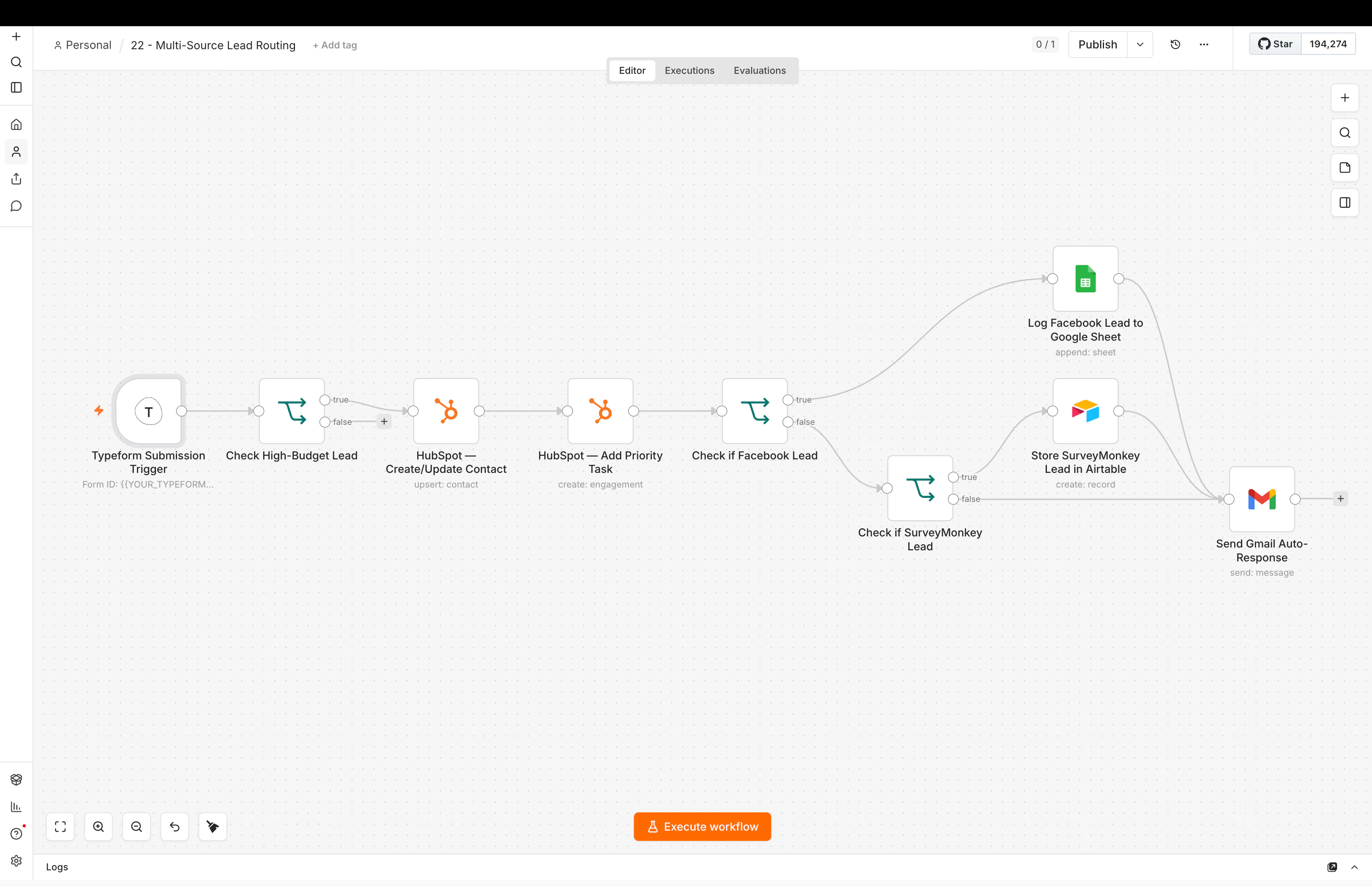
n8n vs Zapier for Business Automation
People often ask which automation platform is "better."
I think that is the wrong question.
The useful question is:
Which one makes this workflow easier to build, operate, debug, and change?
I use both.
Sometimes I also use custom code.
The workflow should decide.
When I usually choose Zapier
Zapier is a strong fit when the job is mostly a clean handoff between supported apps.
For example:
Form submission → filter → CRM record → Slack alert
or:
Stripe payment → update HubSpot → send follow-up → create task
The advantage is speed.
If the apps are already well supported and the logic is clear, there is no prize for adding more infrastructure.
Zapier also supports filters and branching paths, so simple does not mean one-step only.
You can see examples in my Zapier automation work.
When I usually choose n8n
I prefer n8n when the workflow starts behaving more like a small integration system.
That usually means things such as:
- several API calls
- deeper branching
- data transformation
- multiple CRM lookups
- custom code inside the workflow
- reusable workflow pieces
- AI steps surrounded by normal rules
- complex routing
- more control over how data moves between systems
A lead routing workflow is a good example.
The workflow might receive a lead, enrich the company, normalize the fields, inspect CRM history, apply qualification logic, ask an AI model to classify unstructured context, route the lead, update the CRM, and notify the correct owner.
At that point, control becomes more important than getting the first version live in ten minutes.
My n8n automation work shows examples across CRM sync, onboarding, routing, follow-up, and reporting.
If you are new to the platform, I also wrote about how hard n8n is to learn and what actually makes it difficult.
What about custom code?
Sometimes neither Zapier nor n8n is the cleanest answer.
Custom code starts to make more sense when the workflow is becoming part of a product.
For example:
- users need a custom interface
- permissions are complicated
- the logic is very specific to the product
- performance needs tighter control
- the process needs a database model built around it
- the automation is really an application feature
That does not mean code is always better.
Code gives you more control, but it also gives you more responsibility.
You need to maintain the application, deployment, security, monitoring, and errors.
I usually ask whether the extra control is worth that cost.
A simple way I compare the options
My starting point is simple:
- Simple handoff between common apps: I usually start with Zapier.
- APIs, branching, data work, AI, or multi-step integrations: I usually look at n8n.
- Product-specific logic or a custom user experience: I consider custom code.
- A workflow that mostly lives inside the CRM: I first check whether the CRM can handle it natively.
This is not a hard rule.
It is a starting point.
The workflow should decide the tool
A common mistake is choosing the platform first and forcing every problem into it.
Instead, map the workflow:
- What triggers it?
- Which systems are involved?
- How much branching exists?
- Does the workflow need custom API calls?
- How important is debugging and retry behavior?
- Who needs to maintain it later?
- Does a user need a custom interface?
Then choose the smallest tool that can handle the job reliably.
Sometimes I use more than one tool
A business does not need one automation platform for every process.
Zapier can handle simple SaaS handoffs while n8n handles a more involved integration layer elsewhere.
GoHighLevel or HubSpot may handle CRM-native automation without either tool.
Custom code may handle one product-specific part.
That is fine.
The architecture should be boring enough that the next person can understand why each piece exists.
What about AI?
AI does not change this decision as much as people think.
The important question is still what the workflow needs.
If an AI step is only summarizing a form response, either platform may be fine.
If the AI step sits inside a larger process with enrichment, API calls, fallbacks, validation, and several routing paths, I usually want the deeper control of n8n or application code.
The model should be one component of the system, not the system itself.
I explain that approach in when to use AI in an automation and when to use normal rules.
Is n8n overkill?
It can be.
If your whole workflow is:
Form → CRM → notification
then a simpler tool may be better.
If the process needs many APIs, branches, checks, and transformations, n8n starts to earn its place.
I wrote a separate guide on when n8n is overkill for a small business because that question deserves more than a one-line answer.
The main lesson
Do not choose n8n because it looks more technical.
Do not choose Zapier because it looks easier.
Do not choose custom code because it feels more powerful.
Choose the option that makes the process easiest to trust and maintain.
The best automation platform is the one that solves the workflow without creating a bigger problem around it.
If your real problem is deciding whether the workflow should exist at all, read When Is Automation Worth It?.
Further reading
Automation communities regularly ask which tools are worth using for small-business workflows and whether the n8n learning curve is justified. Zapier's documentation on filters and paths is also useful when judging how far a Zap can go before the architecture needs something else.