
Growth Automation
Make growth work as one connected system.
I connect marketing, content, search, acquisition, distribution, analytics, and reporting so each part creates context for what happens next.
Growth automation should close the loop.
Campaigns, content, search, distribution, analytics, and reporting are most useful when the outcome of one becomes context for the next decision.
The strategy stays human. The system shortens the distance between activity, evidence, and the next move.
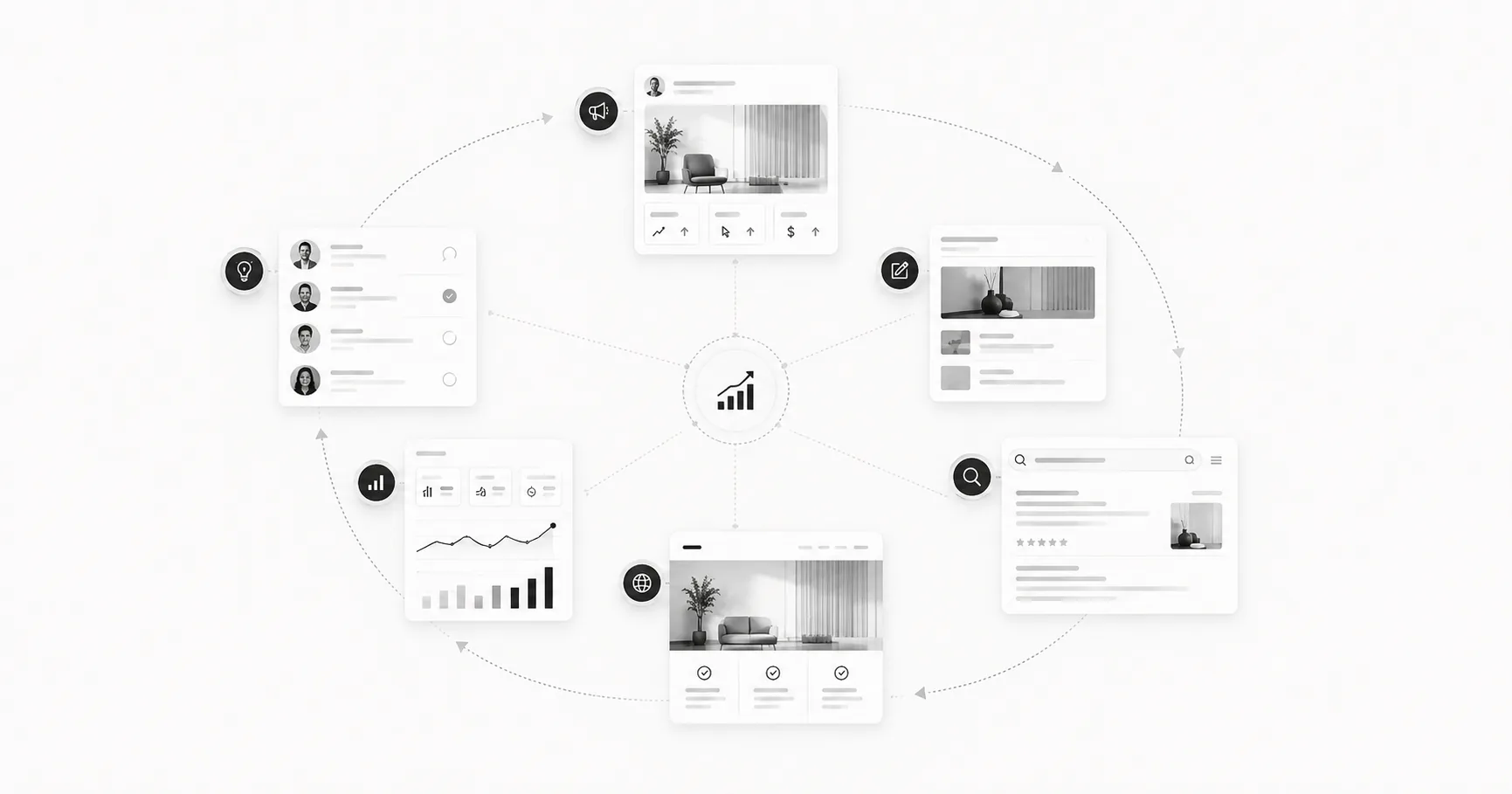
One loop from attention to learning what works.
Growth automation ties experiments to business decisions
A growth system is not another name for marketing campaigns, content production or SEO audits. It is the operating loop that selects a hypothesis, captures evidence from acquisition and conversion, decides what changed, and makes the next test possible. It matters most when teams run activities in parallel but cannot explain which constraint is holding growth back.
How decisions are made
Choose the bottleneck before connecting another tool
Define the business question first: not enough qualified enquiries, low booking rates, a slow handoff, poor activation or weak repeat engagement. Each is a different constraint and requires different data from marketing, product and operations.
Select one meaningful event chain, then name the owner and source system for each event. A website session, a form completion, an accepted lead and a delivered service are different observations; joining them requires identifiers and explicit privacy boundaries.
Design the feedback cadence: what is reviewed weekly, who decides whether to continue an experiment, and which measures are unstable or delayed. Avoid allowing an automation to promote a weak conclusion as a statistically certain result.
Worked-through scenario
Example: traffic grows but qualified enquiries do not
Suppose search visits and ad clicks increase while sales reports a flat number of qualified appointments. A generic growth dashboard might celebrate traffic; a useful system investigates the entire path before recommending more acquisition spend.
01
Locate the drop
Compare landing-page engagement, form completions, CRM acceptance and appointment attendance using consistent event definitions and time windows.
02
Separate causes
Check whether pages attract the wrong audience, forms fail on mobile, lead-source data is lost or appointment capacity is constrained. Do not assume all funnel drop-off is a copywriting problem.
03
Run a bounded test
Choose one hypothesis, such as simplifying qualification questions for a specific audience. Document the expected mechanism, decision threshold and potential adverse effects.
04
Close the feedback loop
Review lead quality, operational workload and downstream outcomes. Keep an explicit stop or revise decision and log the result so future campaign, content and SEO work uses the learning.
What I would test: Check events arriving late, cross-device gaps, merged contacts, inconsistent date ranges, misconfigured consent controls, unusually small cohorts and CRM stages that were changed retrospectively. If measurement quality is poor, the right move may be to fix instrumentation before testing a new campaign.
Illustrative implementation walkthrough, not a claim of an additional completed client project.
Scope and acceptance
What a delivery scope should include
- A growth-funnel event map covering acquisition, acceptance, booking and delivery where those data are available.
- A measurement plan distinguishing leading signals from verified business outcomes.
- An experiment backlog, decision log and recurring review report with clear owners.
A useful scorecard tracks qualified conversion by entry page or channel, lead acceptance, booking and handoff completeness, instrumentation gaps and whether an experiment produced enough reliable evidence for a decision. I would not claim a specific uplift without a controlled measurement.
Practical questions
How is growth automation different from marketing automation?
Marketing automation manages campaign context, audience rules, acquisition events and handoffs. Growth automation uses acquisition, conversion and delivery observations to identify a constraint, test a hypothesis and decide what to change. It is a measurement-and-learning loop, not another campaign launcher.
Should we run growth experiments if CRM data is unreliable?
Often the first experiment is fixing measurement. If duplicate records, missing sources or inconsistent stages dominate the dataset, changes in campaign performance are hard to interpret. Stabilize the event definitions and critical handoffs before treating apparent improvements as evidence.
Evidence and references
Demonstrates one part of the acquisition-to-response path. The social activity enrichment project illustrates a downstream input; neither is presented as a controlled growth experiment.
Website-to-CRM intake implementation
Technical documentation: Google Analytics guidance on key events and attributable business actions. Platform features, eligibility, and limits can change.